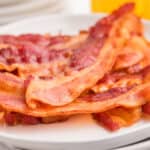
Perfect Bacon In The Oven (Crispy, No Splatter, Easy Cleanup)
Baked bacon is the easiest way to get crispy slices without stovetop splatter. Skip the skillet and bake it instead for golden-brown slices.
Servings 4
Calories 355kcal
Equipment
Ingredients
- 12 ounces bacon
Instructions
- Arrange a rack in the middle of the oven. Heat the oven to 400°F. Line a rimmed baking sheet with aluminum foil, lettingit hang over the edges, and press it into the corners so it forms a shallow "tray" to catch the grease.
- Lay the bacon in a single layer. Slices can touch, but do not overlap or they will stick together.
- Bake 12 to 18 minutes, depending on thickness and how crisp you like it. At about the halfway mark, use tongs to flip the bacon over for more even browning. Start checking at 12 minutes and keep a close eye near the end.Regular bacon is usually done around 12 to 15 minutes.Thick-cut bacon is usually done around 15 to 18 minutes.
- Quick Note: I like to flip my bacon halfway through baking to get both sides evenly crisp.
- Use tongs to transfer the bacon to a paper towel-lined plate. Let it sit 1 to 2 minutes to drain and crisp up, then serve.
Clean up
- Let the pan and grease cool completely. Carefully fold the foil edges inward to contain the grease and discard, or pour the cooled grease into a heat-safe container before tossing the foil.
Servings Sizes
- For 12 ounces of bacon, a good rule is:4 servings if people want 3 slices each6 servings if people want 2 slices eachMost 12-ounce packs are around 10 to 14 slices, so "Serves 4 to 6" is the right call. If it's the main event (big breakfast), call it 4: if it's alongside eggs, pancakes or in a sandwich, call it 6.
Video
Notes
Notes for Perfect Oven Bacon
- Flip halfway for even bacon. I always flip the slices halfway through baking. It helps both sides brown the same and keeps the edges from curling as much.
- Foil is the easiest cleanup. I prefer lining the pan with foil because you can fold it up and toss it once the grease cools. Less scrubbing, more bacon.
- Parchment works, but cleanup is not as easy. You can use parchment paper if you want, but it does not contain the grease as neatly as foil, so cleanup can be messier.
- Use a rimmed baking sheet. Bacon grease is not easy to contain. A rimmed pan is necessary and keeps it where it belongs.
- Check early, finish strong. Start checking around 12 minutes. Bacon goes from “almost” to “too far” fast.
- It crisps as it rests. Pull it when it looks deep golden and still just a tiny bit flexible. After a minute or two on paper towels, it firms up and gets crisp.
- Thickness changes everything. Regular bacon usually takes around 12 to 15 minutes. Thick-cut is more like 15 to 18.
- Save the grease if you cook the old-fashioned way. Let it cool, then strain into a jar and refrigerate. Great for frying eggs or seasoning veggies.
Nutrition
Serving: 1 | Calories: 355kcal | Carbohydrates: 1g | Protein: 11g | Fat: 34g | Saturated Fat: 11g | Polyunsaturated Fat: 5g | Monounsaturated Fat: 15g | Trans Fat: 0.1g | Cholesterol: 56mg | Sodium: 563mg | Potassium: 168mg | Vitamin A: 31IU | Calcium: 4mg | Iron: 0.3mg